Tel/wechat/whatsapp : +86 13758983507
Email : info@homeindoor.cn
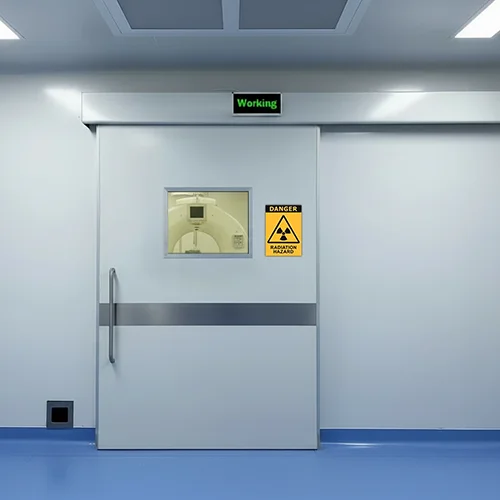
A radiation protection door, also called a lead-lined door or X-ray shielding door, is a specially designed door used to block radiation from passing through a room opening. It is commonly installed in medical imaging rooms, radiotherapy areas, nuclear medicine departments, laboratories, and industrial inspection facilities.
Unlike a normal steel door, a radiation protection door contains shielding material inside the door leaf and frame. The most common shielding material is lead sheet because lead has high density and excellent radiation attenuation performance. When X-rays or gamma rays reach the door, the lead layer absorbs and weakens the radiation, helping protect doctors, nurses, technicians, patients, staff and people in nearby areas.
A radiation protection door is not an independent product only. It must work together with the complete room shielding system, including walls, ceiling, floor, lead glass windows, service boxes, and penetrations. If the door is well protected but the frame gap or wall joint is not shielded properly, radiation leakage may still occur. Therefore, a good radiation protection door must provide continuous shielding from the door leaf to the frame, hinges, lock area, bottom seal, and surrounding wall connection.
The main purpose of the door is to control radiation exposure and keep the dose level outside the protected room within the required safety limit.
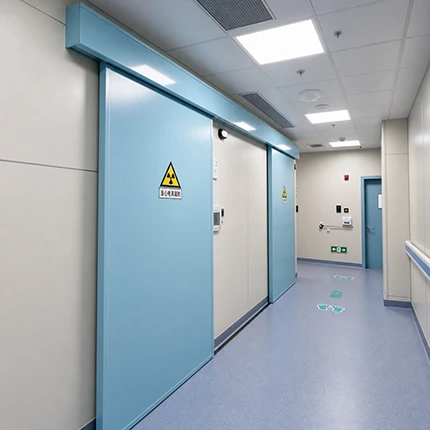
A radiation protection door is usually built as a multi-layer shielding structure. The exact design depends on radiation energy, required lead equivalence, door size, opening method, and project standard.
The door leaf normally includes the following layers:
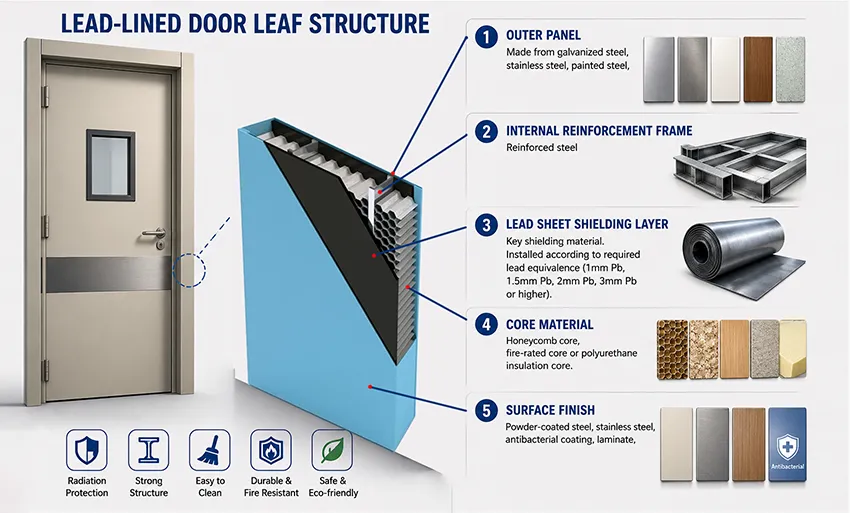
Outer Panel
The outer panel can be made from galvanized steel, stainless steel. For hospitals and laboratories, steel and stainless steel finishes are common because they are durable, easy to clean, and suitable for high-traffic areas.
Internal Reinforcement Frame
Inside the door leaf, a reinforced steel is used to support the weight of the lead sheet. Lead is heavy, so the internal structure must be strong enough to prevent deformation, sagging, or long-term bending.
Lead Sheet Shielding Layer
The lead sheet is the key shielding material. It is installed inside the door leaf according to the required lead equivalence, such as 1 mm Pb, 1.5 mm Pb, 2 mm Pb, 3 mm Pb, or higher. The lead sheet should be continuous and properly overlapped at joints to avoid radiation leakage.
Core Material
Depending on project requirements, the core material may include honeycomb core, mineral core, fire-rated core, or polyurethane insulation core. For medical projects, the core provide stability, flatness, durability, and good bonding with the lead layer.
The frame is just as important as the door leaf. A radiation protection door frame is made from galvanized steel or stainless steel with lead lining. The lead sheet inside the frame should connect with the wall shielding and overlap with the door leaf shielding when the door is closed.
Some radiation protection doors should include a vision window for observation. This window cannot use ordinary glass. It must use lead glass with suitable lead equivalence as the door. The glass frame also is shielded to prevent leakage around the edge.
Radiation protection doors can be classified by opening method, material, and application area.
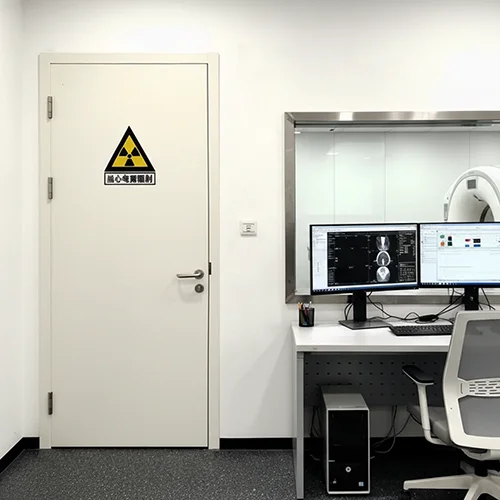
A hinged radiation protection door opens like a normal swing door. It is widely used in X-ray rooms, dental rooms, small imaging rooms, laboratories, and control areas.
Advantages:
Simple structure
Easy to install and maintain
Good sealing performance
Suitable for small and medium openings
Can be manual or automatic
Lower cost compared with large sliding doors
Applications:
Dental X-ray rooms
General radiography rooms
Small CT rooms
Medical laboratories
Veterinary imaging rooms
Hospital control rooms
Hinged lead-lined doors are ideal when the door size is not too large and there is enough swing space.
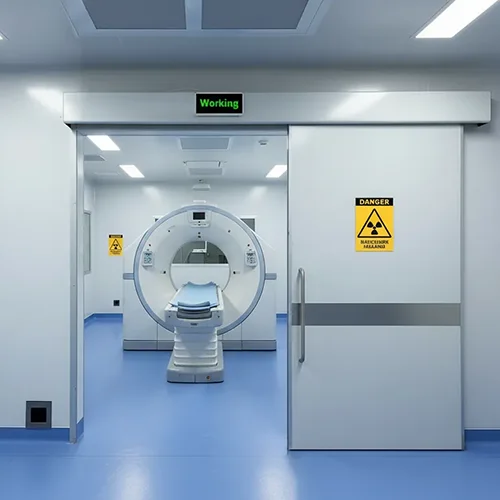
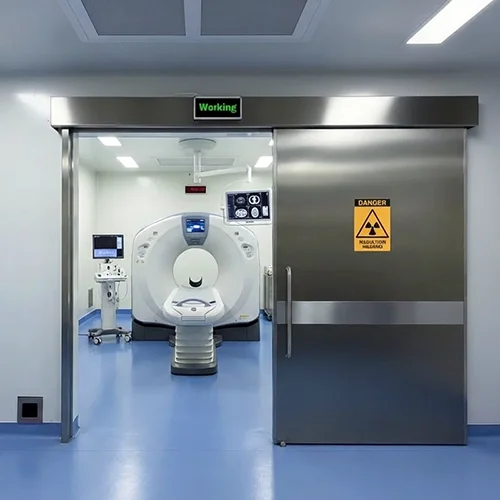
A sliding radiation protection door moves horizontally along a track. It is commonly used in hospitals because it saves space and allows convenient movement of patients, beds, and equipment.
Advantages:
Suitable for wide openings
Saves swing space
Easy for hospital beds and trolleys to pass through
Can be manual or automatic
Good for high-traffic medical areas
Applications:
CT scan rooms
DR rooms
Fluoroscopy rooms
Operating imaging rooms
Nuclear medicine rooms
Radiology departments
Automatic sliding radiation protection doors are especially popular in modern hospitals because they improve workflow and reduce physical contact.
Lead thickness is usually described as “lead equivalence,” such as 1 mm Pb or 2 mm Pb. This means the door provides shielding performance equivalent to that thickness of lead.
However, lead thickness cannot be selected only by room name. It depends on several factors:
Type of radiation equipment
Tube voltage or radiation energy
Workload of the equipment
Distance from radiation source to door
Direction of primary beam
Scatter radiation level
Occupancy of nearby areas
Controlled or uncontrolled area classification
Local radiation protection regulations
Wall and room shielding design
For example, a dental X-ray room may need a lower lead equivalence than a CT room. A CT room may need a higher lead thickness because of higher workload and scattered radiation. A radiotherapy room may require a completely different heavy shielding system.
The following table is only a general reference. Final lead thickness must be confirmed by a qualified radiation protection professional according to the shielding report.
| Application Area | Common Radiation Source | Typical Lead Equivalence Reference |
|---|---|---|
| Dental X-ray room | Low-energy X-ray | 0.5 mm Pb – 1.0 mm Pb |
| General X-ray / DR room | Diagnostic X-ray | 1.0 mm Pb – 2.0 mm Pb |
| Mammography room | Low-energy diagnostic X-ray | 0.5 mm Pb – 1.0 mm Pb |
| Fluoroscopy room | Continuous or pulsed X-ray | 1.5 mm Pb – 3.0 mm Pb |
| CT scan room | High workload scattered X-ray | 2.0 mm Pb – 4.0 mm Pb |
| Nuclear medicine room | Gamma radiation | 2.0 mm Pb – 6.0 mm Pb or higher |
| PET/CT room | High-energy gamma radiation | Custom design, often much higher |
| Radiotherapy room | High-energy radiation | Custom heavy shielding system |
The required lead thickness must match the shielding report for the whole room. The door, frame, window, wall, and all joints must have continuous shielding. If the wall requires 2 mm Pb equivalent, the door and frame should normally be designed to match the required door shielding value in the project report.
A radiation protection door should also be tested or inspected after installation. The inspection should confirm:
Door leaf lead thickness
Frame shielding continuity
Door gap protection
Lead glass equivalence
Joint overlap
Radiation leakage around hinges and lock area
Smooth mechanical operation
Safety performance of automatic systems
Radiation dosage outside the room is controlled by shielding thickness. In simple terms, thicker lead reduces more radiation. But the relationship is not based only on thickness. Radiation energy, exposure time, distance, and room layout all affect the final dose level.
A good shielding design follows three basic radiation protection principles:
The purpose of a radiation protection door is to reduce radiation exposure outside the room to an acceptable level for staff and the public.
We have no minimum order quantity and accept orders in any quantity.Whether you need a single door or material for an entire project, we offer affordable product price and shipping to your country
Any size within the maximum size range can be customized,
Of course,We have a wide range of standard colors to choose from, and we can also produce according to the color card provided by the customer.
Of course, we can ! Our profesional designer can provide detailed design drawings to confirm the specifications and materials before production.
You can also download reference drawing on our website
Of course, we can provide different materials, colors, styles, prices of hardware accessories for customers to choose, where you can one-stop shopping for doors and accessories! Most of our hardware is made in china (chinese brand), We can also supply hardware made by international Top brands (such as Häfele, Dorma), or Equivalent China-made hardware
Tel/wechat/whatsapp : +86 13758983507
Email : info@homeindoor.cn
Scan to contact us by wechat

Copyright Homein Door Limited